By Bruce Urben, WWA President
Photo credit: Bruce Urben

By Bruce Urben, WWA President
Photo credit: Bruce Urben
The Fox River Valley, which includes Neenah/Menasha, was a waterfowling hotbed in the 1900s. The Marshes and lakes were full of wild rice, wild celery, and Wapato; all waterfowl desired delicacies. Neenah and Menasha were also “Mill” Towns as they still are today. This carver lived his whole life in Neenah, WI, where his family settled after immigrating from Germany.
According to historical records, Menasha was generally home to mill workers, and Neenah was home to Mill owners.
Ernest F. Wieckert was born in Germany in 1845, immigrated to Neenah in 1866, and later married Marie Miller. Ernest was employed in the “milling” business. He initially opened a furniture store in 1868, which subsequently burned, and later purchased a wood planing mill in 1880, which turned into the E.F. Wieckert Lumber Co. In addition to his lumber mill, he was also a home builder in the Neenah area. One of his most significant construction projects was the Neenah City Hall.
Ernest and his wife had one son, Harold E. Wieckert, born in 1895 in Neenah, who succeeded his father as President of E.F. Wieckert Lumber Co in 1923 at the age of 28. Harold went on to run the Lumber Co. in Neenah for his entire life.
In addition to Lumber and home construction, Harold was an avid waterfowler, hunting on Lake Winnebago, the Fox River, and area marshes. It only seemed logical that Harold would begin carving his own decoys, as he had full access to the lumber needed to make them. Harold started carving decoys in his 20s and made primarily hunting decoys for his own use. Many of his decoys were gifted to friends and family. It is reported that he carved hundreds of decoys in his lifetime!
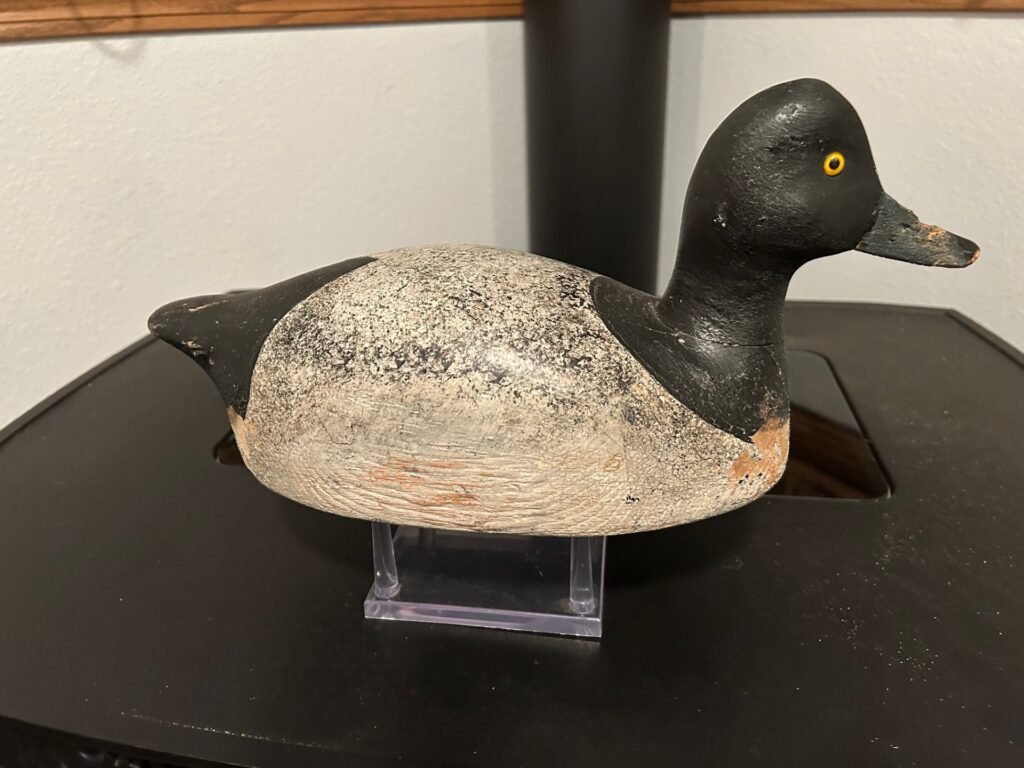
He primarily carved solid and hollow-bodied bluebill and canvasback decoys. Many were constructed of pine bodies and heads. He carved a high-head decoy that was popular on Lake Winnebago. His head was relatively narrow, with some bill carving and excellent bill separation carving at the head. Most of his bodies had a slight humpback with a short, angular tail extending up from the rump.
Harold’s paint style was simple and representative of the species he was carving. He used exterior oil-based house paint, which included dark head and neck as well as tail delineation. All of Harold’s decoys that I have seen had glass eyes, and very few were signed.
Harold was one of the first Winnebago carvers to use a unique drop-type wire weight at the bottom of his decoys, which added stability in the rough, icy waters of Lake Winnebago.
Harold E. Wieckertwas the son of German immigrants. He worked in the lumber business that his father established and built houses his entire life. His passion, however, was waterfowling and a successful career in carving Winnebago-style decoys. Lucky is the collector who has Harold Wieckert decoys in their collection!
Harold passed away in 1948 at the age of 53. Harold E. Wieckert, another classic Winnebago area carver and Wisconsin Original!