 By Mark Pfost, Public Lands Ecologist – mpfost@wisducks.org
This article originally appeared in the Wisconsin Waterfowl Association’s August 2026 Newsletter edition.


By Mark Pfost, Public Lands Ecologist – mpfost@wisducks.org
This article originally appeared in the Wisconsin Waterfowl Association’s August 2026 Newsletter edition.
I’ve written several articles highlighting work on the Little Yellow River Watershed Project (LYR); those typically described work to be done, or work completed. This article’s emphasis will go in a different direction. Knowledge of, and interest in, this project is expanding beyond Juneau County.
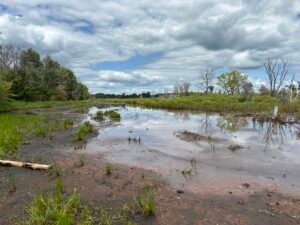
Last month, Brad Strobel (FWS wildlife biologist) and I gave a tour to Paul Burns, a fisheries biologist who restores Oregon rivers using “stage 0,” a technique that resets elevations to a pre-disturbed condition. It has similarities to our work in the LYR. Burns, a UWSP alum, was home for a visit and asked Tracy Hames (Wisconsin Wetlands Association) where he should go to see a large high-quality wetland restoration project. Tracy brought Paul to us and the LYR. It was a pleasant hike through wetlands, and we discussed similar work in very different landscapes.
This month, Strobel and I led another tour—this time with members of the governor’s Wetland Study Council. The Council makes recommendations related to wetland research needs, policies, permitting, and management to the governor. Seven of the Council’s nine members (including new Council member, WWA Project Director, Peter Ziegler) were on the field trip. It was an exceedingly hot day, causing us to tarry longer over the “slide” presentation than we might have on a cooler day, but we did get out to numerous locations so Council members could see not only the extent of the project, but the effects of “erasing” ditches. We touched on the watershed’s geography and history before moving into the string of events that led to restoration of the Little Yellow River’s west branch and the filling of miles of ditches leading into it.
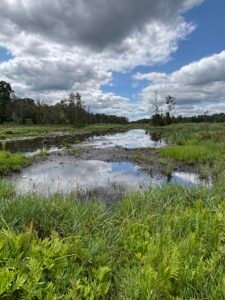 While I don’t remember all points discussed, we emphasized the importance of building relationships and partnerships. We were queried, among other things, about permitting, planning decisions, construction, and maintenance. Members were interested in how the project reduces downstream flooding. One question I do remember was along the lines of “what concerns did you have?” My reply was that the project’s scale added a “fear factor.” What would happen if we screwed this up? But we haven’t. We tried to impart to Council members the mindset that practitioners should approach big opportunities as “what can we do?” Not looking for reasons why it can’t be done. In one form or another, Council members will incorporate what they saw and learned into future deliberations.
The project’s scale and its partnerships are getting noticed outside of northern Juneau County. A model? An example? We’ve presented this project in multiple forums outside of the local area and anticipate more presentations and field trips in the future—to whom and when is yet to be determined.


