 By Mark Pfost, Public Lands Ecologist – mpfost@wisducks.org
This article originally appeared in the Wisconsin Waterfowl Association’s March 2026 Newsletter edition.

By Mark Pfost, Public Lands Ecologist – mpfost@wisducks.org
This article originally appeared in the Wisconsin Waterfowl Association’s March 2026 Newsletter edition.
The theme of last month’s annual meeting of the Wisconsin Chapter of The Wildlife Society was “Applying the North American Model of Conservation During Divided Times.” I was asked to speak at WCTWS’s symposia on wetland management, and I structured my talk to fit the theme. I wanted to explore the similarities and differences in how the North American Model of Conservation (informally, the Model) applies to whether a particular piece of land is public or private. I also wanted to highlight different WWA projects on state lands, discussing them through the lens of the Model.
I assume WWA members know the Seven Pillars (sometimes call the Seven Sisters) of The Model: 1) wildlife as a public trust; 2) no commercial markets for wildlife; 3) allocation of wildlife by law; 4) kill wildlife for legitimate purposes only; 5) wildlife is an international resource; 6) science is the proper tool for wildlife management; and 7) democracy of hunting.
We know the history behind The Model, from George Bird Grinnell’s forming of the Audubon Society in the late 1800’s through Teddy Roosevelt, Gifford Pinchot, John Muir, Aldo Leopold, up to, and including, today’s WWA members. We know its roots lie in the Lacey Act, the Migratory Bird Treaty of 1916, the P-R and D-J Acts, “duck stamps,” the science of wildlife management, and the wetland work we and others do every day. The Safari Club and The Wildlife Society seem to have been the organizations that “codified” the component parts into the Model. And it, like any other model, is argued about and argued over.
Scott Walter, the new Director of the DNR’s Wildlife Management Program, spoke in depth about each of these topics during his plenary presentation. Scott’s talk freed me to focus part of my talk on the democracy of hunting as it applies to land ownership.
When I, as a private-lands biologist, gave presentations, I started with a plain old road map and explained that the map had three colors: yellow, green, and white. Yellow indicated urban/suburban areas where there wasn’t much opportunity for wildlife or wildlife habitat work. Green was public lands—federal, state, county, and so on. As important as those lands were, they could not provide the habitat and wildlife desired by society. That left the white space—private lands—to fill the void.
Now I flip the map. Yellow still has fewer opportunities. Private land habitat is extremely important, but is generally less scientifically managed than public lands; less research is conducted on private lands; and private lands do not fulfill the democratic principles of the hunt. But WWA’s wetland work on state wildlife areas not only enhances habitat for wildlife but also enhances those places for all of us to enjoy.
I explained this with a story. A dozen or so years ago, I restored a wetland on John’s private property. “King John” for the purposes of this story. King John invited me to hunt ducks on his property pretty much whenever I wanted, but he also told me, quite emphatically, that if he caught me hunting deer on his property, he would kick me off. Under our land ownership system, he has every right to do so.
And that is OK; while venison may fill my freezer, it is ducks that fill my soul.
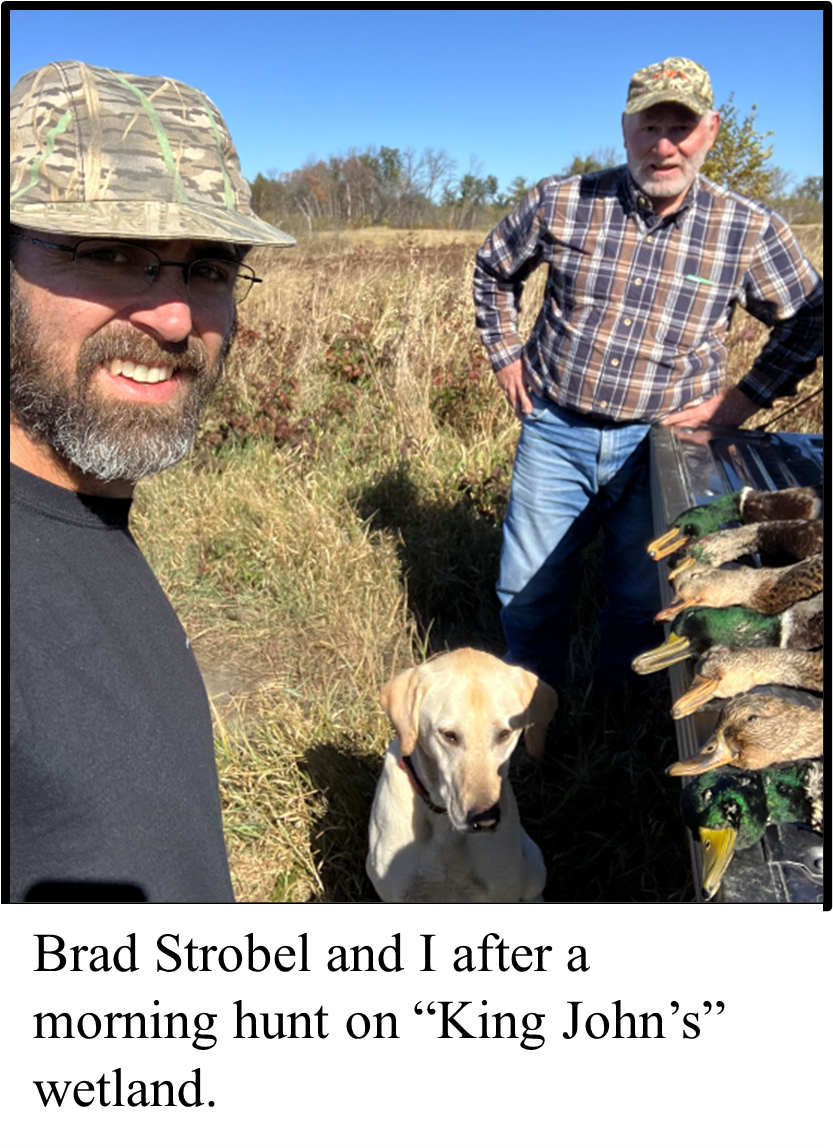
On King John’s place, I am a duck hunter, a sportsman, and a guest. As a deer hunter, I would be a trespasser and, potentially, a poacher. Plain and simple, black and white.
That is not the case on public lands. We have no King Johns. You and I, and everybody else, are free to walk those lands and hunt and fish within limits established by law and regulation. The State doesn’t own the Nation’s wildlife; it is owned by the Public writ large and managed for the benefit of the Public by state and federal agencies. A public land manager cannot arbitrarily say, “No, you can only hunt deer, not ducks, on this public property.”
King John can sell his land to King George or King Henry. Each could end my access. The public land manager cannot do that.
Going all the way back to Pinchot and Muir, we’ve tended to label outdoor enthusiasts as either “hook and bullet” folks or tree huggers and environmentalists. I belong to both those camps, and as a wildlife biologist and wetland ecologist, I am also science-minded. Effectively, I wear all of these “hats,” which brings me to my main point about the Model and the democracy of the hunt.
The majority of enthusiasts—regardless of their “hat” depend on public lands. We have the power to influence both the quantity and quality of public lands’ habitat. A simple example of this is WWA’s effort to advocate for the continuation of the Knowles-Nelson Stewardship Fund.
We’ve also had periods of time—stretching from the days of TR until this very day—in which we have had to protect our public lands from those who would sell them off for this reason or that. Public lands, once lost, will not be regained, and the democracy of the hunt could vanish, acre by acre.


