A Decoy Corner Article
By Bruce Urben, WWA President
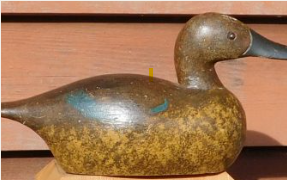
Pictured above is an Arenz Blue Wing Teal decoy. Photo credit: Wisconsin Sporting Collectibles

By Bruce Urben, WWA President
Pictured above is an Arenz Blue Wing Teal decoy. Photo credit: Wisconsin Sporting Collectibles
The City of Fond du Lac is located on the south end of Lake Winnebago in Fond du Lac County. Lake Winnebago is one of the largest inland lakes in the United States and the largest in Wisconsin. It is almost 28 miles long and 10 miles wide, and was a waterfowl hunting hotspot in the 1900s. Long Point Island, located off the west shore of Winnebago between the Cities of Oshkosh and Fond du Lac, provided some of the finest waterfowling in the State, which continues to this day! Lake Winnebago provides many marshes and cane areas with good forage plants for waterfowl. According to records, the fall migration of waterfowl here in the 1900s was phenomenal. This area is where Mr. Seraphin Arenz lived, carved, and hunted.
Seraphin (Serph) N. Arenz grew up in this area of Fond du Lac near the waters of the Winnebago. Serph was born in September of 1903 to Michael Arenz and his mother, Gertrude Wettstein. His parents immigrated from Germany to America
in the late 1800’s. They were farmers and craftsmen. Serph followed in his father’s footsteps as an avid waterfowler, using Lake Winnebago to put food on the table in his early years.
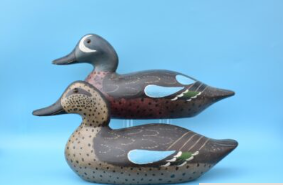
Serph didn’t begin carving decoys until his late 30s because of need and continued until the 1970s. Mason and Evans “factory” decoys were available for hunters then, but were sometimes too expensive for average waterfowlers during the depression in the 1920s. When Serph began carving, there was no question that he used both Mason and Evans decoys for his patterns. There was a very close resemblance. He later developed his own style, but also seemed to copy many of his carving peers in the area.
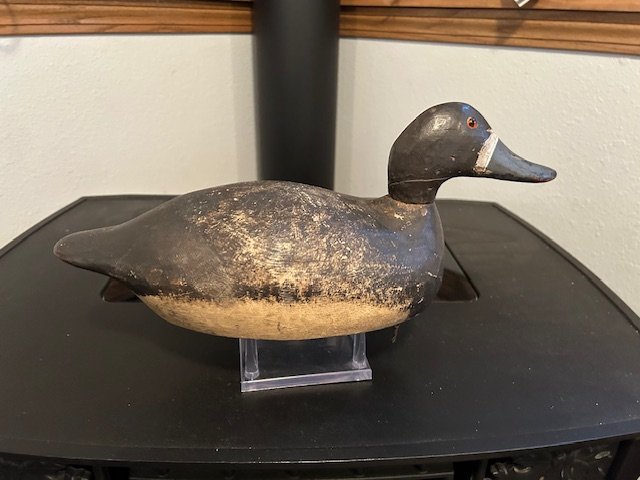
He carved his decoys from pine and cedar and used glass eyes in most of them. His decoys had high heads with very good bill detail, clearly the dominant Winnebago style. Serph’s paint style was very simple in the beginning, with blending and shading, but later continued to copy the Mason style with scalloped breast swirls.
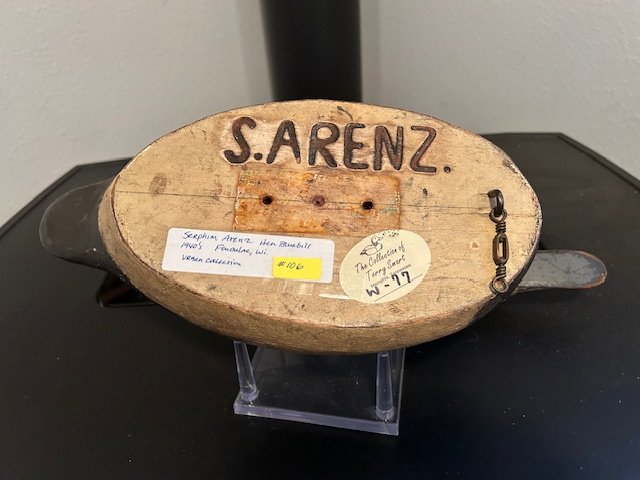
All of Serph’s decoys that I have seen had high heads, which are useful in Lake Winnebago’s winds and waves. We know that Serph produced diver decoys, including Canvasback and Bluebills, as well as Bluewing and Greenwing teal and mallard puddlers. Whatever he carved, his paint style captured the essence of the species! We also know that Arenz carved several floating silhouette decoys that he used in his own rig in the 1950’s. Most of Serph’s decoys have his name (S ARENZ) burnt into the bottom of each decoy, so most are easily recognized.
While Serph did not produce 1000’s of decoys, many of his decoys are well-constructed, have stood the test of time, and can still be seen for sale in pretty good condition. As you might expect, Serph’s decoys are in high demand by collectors, particularly Winnebago Lakes collectors!
Seraphin N. Arenz passed away in June of 1981 at the age of 77. He is buried in Fond du Lac, Wisconsin.
Another classic Wisconsin decoy carver and waterfowler!