This article appeared in the Wisconsin Waterfowl Association’s April 2026 Newsletter edition.
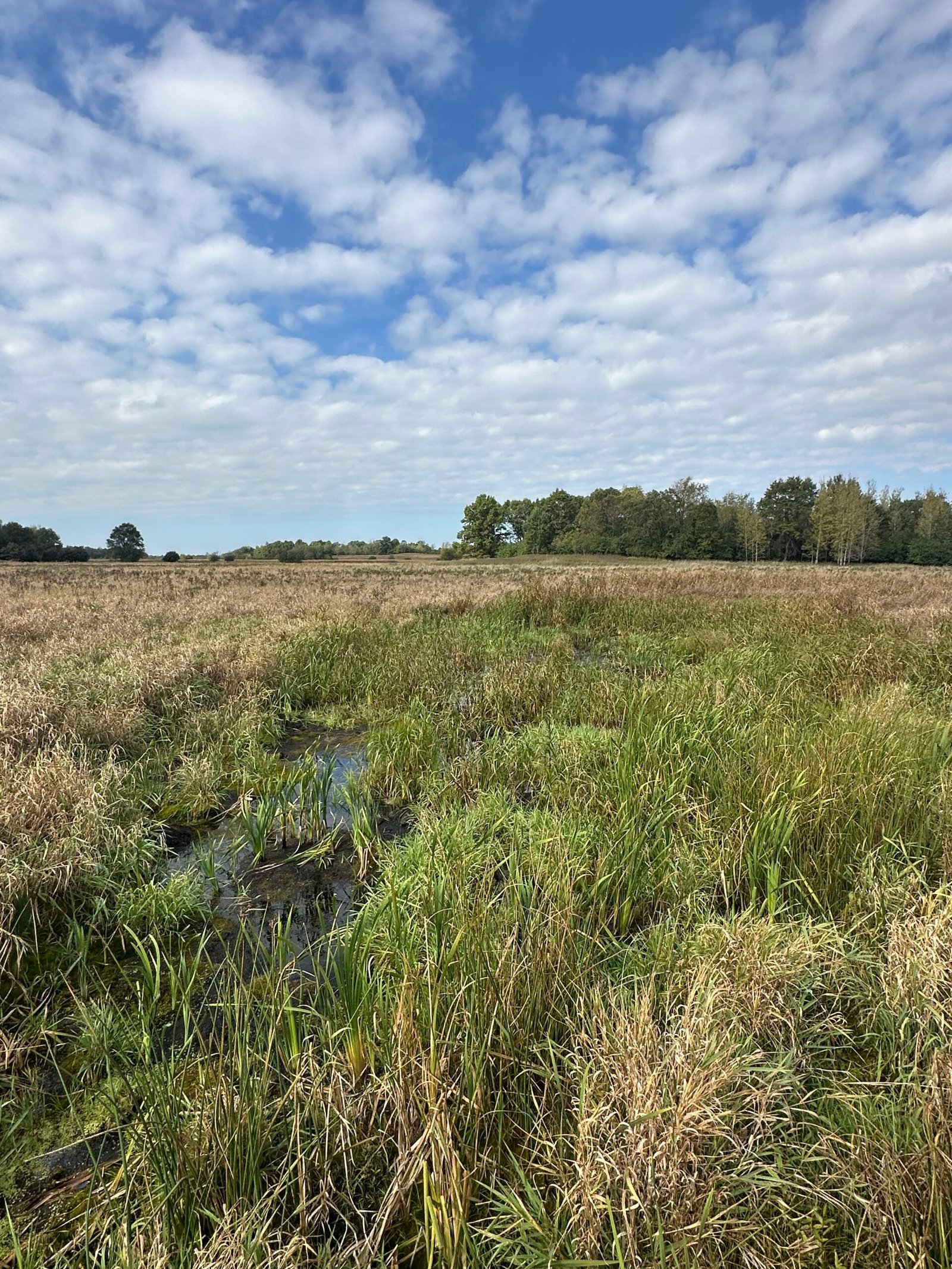
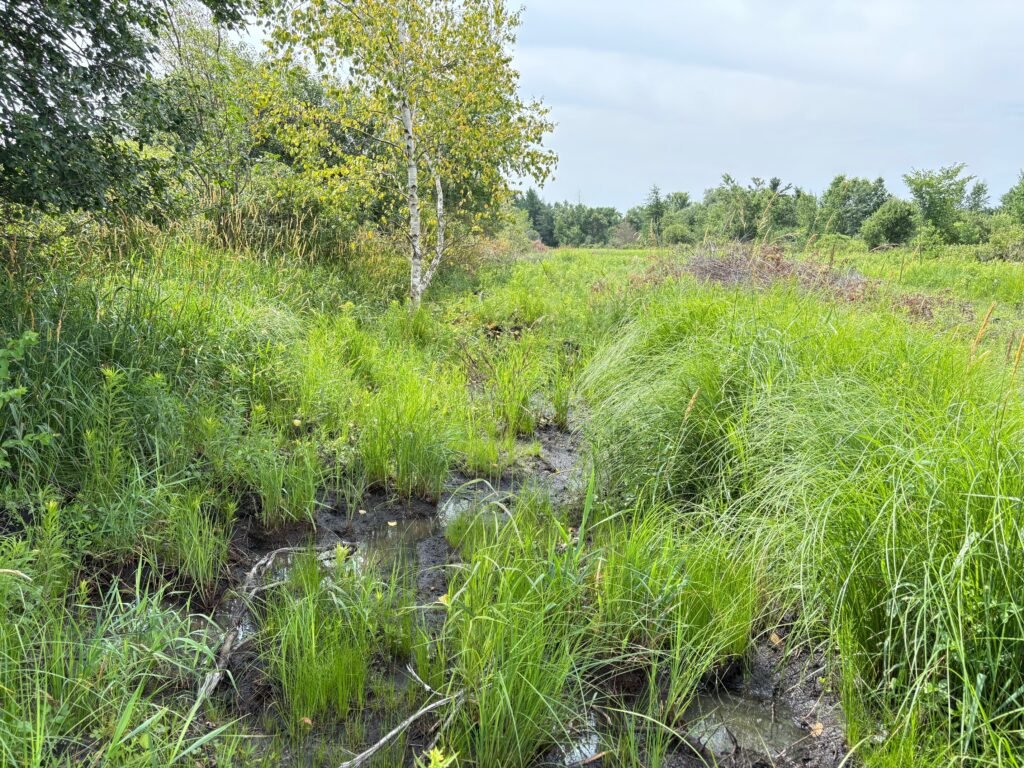
Pictured above, at the White River Fishery Area, the ditch fill has quickly revegetated with predominantly native wetland vegetation and we are beginning to see a positive response to the hydrologic restoration. In the wetland scrape invertebrates, wildlife and plants are finding a niche. Photo credit: Anna Rzchowski.
Wood ducks have returned to the oak woods around my home, foraging on the creek and flying from tree to tree, shopping for the perfect cavity. I leave work in the evenings, still a little surprised that there’s still daylight. And whenever I hold a drip torch in my hand, I celebrate spring and appreciate the landscape that raises ducks, turkeys, morels, blackcaps, maple syrup, and the many other things I enjoy.
I’m sure you’ve all seen the smoke plumes across the state, the hazy air, or the blackened prairies, wetlands, and woods across the state that will soon be filled with new green growth reinvigorated by recent flames. It’s prescribed fire season in Wisconsin, a time of year that, as a practitioner, is exciting and renewing. It’s one of many signs that spring is on its way.
Prescribed fire is an extremely useful tool for maintaining Wisconsin’s habitats, including its wetlands. Wisconsin’s native plant communities thrive in the presence of fire, quickly bouncing back after a burn. Fire can be used to influence the structure of the landscape, improving habitat for wildlife. Nitrogen is volatilized and released into the atmosphere when fuels burn. While many native plants thrive under these conditions, nitrogen-loving plants like reed canary grass falter when these nutrients are removed from the soils. Anyone who has fought their way through a dense knee-deep mat of reed canary grass in a wetland can agree- that’s a good thing!
One component of prescribed fire that I draw actually has very little to do with ecology, though. At the end of a burn, sweaty and sooty crew members convene, catching up on hydration and salty snacks while they complete the “After Action Review” (AAR). At its simplest, the AAR addresses four main questions: What was planned? What actually happened? Why did it happen? And, maybe most importantly, what are we going to do next time?
In these AARs, topics vary wildly. Quality of communication; coordination between crews; fire behavior; whether the ignition plan, staffing, and equipment were appropriate to the unit, site goals, and day-of conditions; and whether objectives were met.
Six months after construction at Peter Helland Wildlife Area, the ditch plugs and water control structure have spread water laterally across the restoration area, and we’re seeing more open-water habitat and a healthier plant community. For duck hunters, this restoration provides essential nesting and brood rearing habitat to increase local bird numbers, as well as creating some open water habitat to hunt over. Photo credit: Blake Bartels, WWA Habitat Technician
Whenever I’m in the area, I like to make a quick pit stop at our previous wetland restorations. Change happens gradually, and opportunistic visits are one way to keep tabs on our work and glean valuable information on how to approach future restorations. As I walk these wetlands, I like to conduct an AAR in my head. What worked well, what didn’t, and what surprised me? It gives me plenty of time to consider the question: Is this project a success?
Like most things in restoration, the answer is complicated. Each project we put on the ground comes with successes and lessons learned. What’s more, the process of restoring a wetland is a long one. There’s no such thing as “done.” There are ongoing management needs to ensure that the wetlands continue to provide for the wildlife and humans that appreciate and utilize them. Because of this, we’re evaluating success throughout the process- and what makes a good wetland restoration is going to look a little different at every site.
Success might look like a huntable wetland, but not always- here is a short list of other definitions. No single measure of success in isolation is adequate for evaluating a project properly, and this list barely scratches the surface of what success could look like.
Providing necessary nesting and brood rearing habitat for waterfowl through pockets of shallow open water and adjacent nesting cover.
An increase in waterfowl and other wetland wildlife observed utilizing the site.
Slowing the release of water off-site during large precipitation events, reducing the risk of flooding downstream.
Restoring subsurface flow of water in a wetland to improve the health of a nearby trout stream.
An improvement in the surrounding vegetation over time.
An improvement in the structural diversity of the habitat available on the site.
Clear communication between WWA, WDNR, and the contractor throughout the construction process.
Taking advantage of good conditions for construction to minimize disturbance to the surrounding areas.
Completing a restoration within the allotted budget.
Cost per acre of habitat restored.
You’ll notice that some of these successes are ecological measures- others relate to implementation, and others still are benefits to infrastructure and people. For some of these measures, we know immediately if we’ve met our goal. In some cases, it may be years before we can begin to draw a conclusion. That’s the nature of restoration and land stewardship, though – it’s an ongoing relationship between humans, wildlife, and the land.

 By Anna Rzchowski, Public Lands Ecologist – arzchowski@wisducks.org