A Decoy Corner Article
By Bruce Urben, WWA President
All photos courtesy Wisconsin Sporting Collectibles
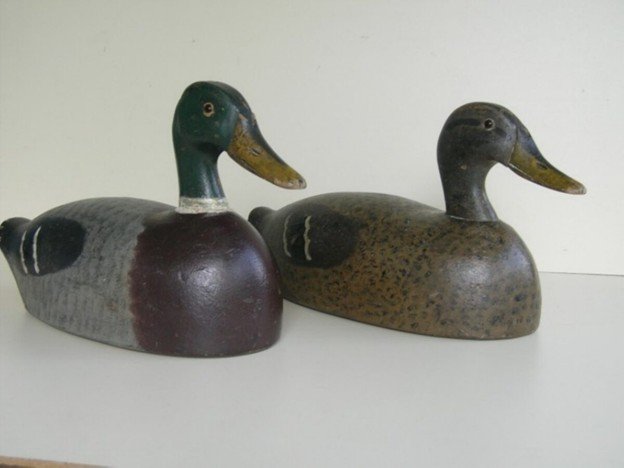
William Hoberg was born in 1882 in Kaukauna, WI, and was one of eight siblings. His father, John, moved the family to Green Bay in 1895 when he founded the first paper mill in Green Bay, Hoberg Paper.
John ran the mill until 1908, when he was killed in a mill accident. His son William took over the mill operation at the age of 26.
William was an avid waterfowler, hunting on the Fox River, Lake Winnebago, and the Bay of Green Bay. His father was not a hunter, but he encouraged William to take advantage of the scores of waterfowl that fed on the abundant celery and duck potatoes, known as “wabato,” that covered the streams and area lakes.

William ended up selling the Hoberg Paper Mill to Procter & Gamble, who used it to make Charmin toilet paper!
Early on, William used factory decoys supplied by local sporting goods stores to fill his rigs. As a well-known sportsman and waterfowler, he began making his own decoys in the 1920s. His first rig consisted entirely of blue-winged and green-winged teal that he used on the western shore of Green Bay. During his carving career, he carved mallards, black ducks, widgeon, teal, buffleheads, and bluebills.
Most of his decoys were made of solid wood, painted in oil house paint using a very realistic speculum blocking for each species. All of his decoys had glass eyes, and the upright head was attached to a neck shelf on the body.

In 1932, William patented the “Hoberg” decoy safety anchor, which featured a mushroom-shaped lead weight attached to a heavy, twisted wire line tie mechanism. These anchors were used extensively on the Bay of Green Bay. All of William’s personal decoys had his last name, “HOBERG,” carved into the bottom in capital letters. William exclusively provided decoys to Louis Barkhausen, a fellow Green Bay industrialist and avid waterfowler. Barkhausen owned a 400-acre Duck Club near Suamico, WI, on the Bay of Green Bay, and a 2000-acre duck Club on the Illinois River. Barkhausen later donated his Green Bay Club to Brown County, which is now home to the Barkhausen Wildlife Preserve. Louis Barkhausen was closely involved in founding Ducks Unlimited (DU) and served as its third President.
William Hoberg passed away in 1985 at the age of 103.
William had a son, “Harold,” who was born in 1914 and followed closely in his father’s footsteps in waterfowling and fine decoy making. Harold made mallards, buffleheads, Redheads, bluebills, and canvasback decoys following his father’s patterns and process. He sold his decoys to his hunting buddies and family friends. Harold’s decoys were fine examples of local folk art!
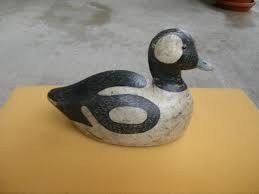
The Hoberg name will be remembered alongside other waterfowling families from the Green Bay region as excellent decoy carvers and avid sportsmen.
As you would expect, Hoberg decoys and anchors are in high demand among collectors and are highly valued. This is probably due to their limited production. Hoberg decoys from the Barkhausen rig are in particular high demand and value. Very few of their decoys are available on the secondary market, and it’s fair to say that Brown County owns many, which are on display at the Barkhausen Preserve and the Green Bay Wildlife Sanctuary.
A true pair of Green Bay Decoy carving Originals!