
This article originally appeared in the Wisconsin Waterfowl Association’s February 2026 Newsletter edition.
WWA Town Hall Meeting Recap
Meeting Purpose
Review the 2025 waterfowl season and plan for 2026–2030 regulations.
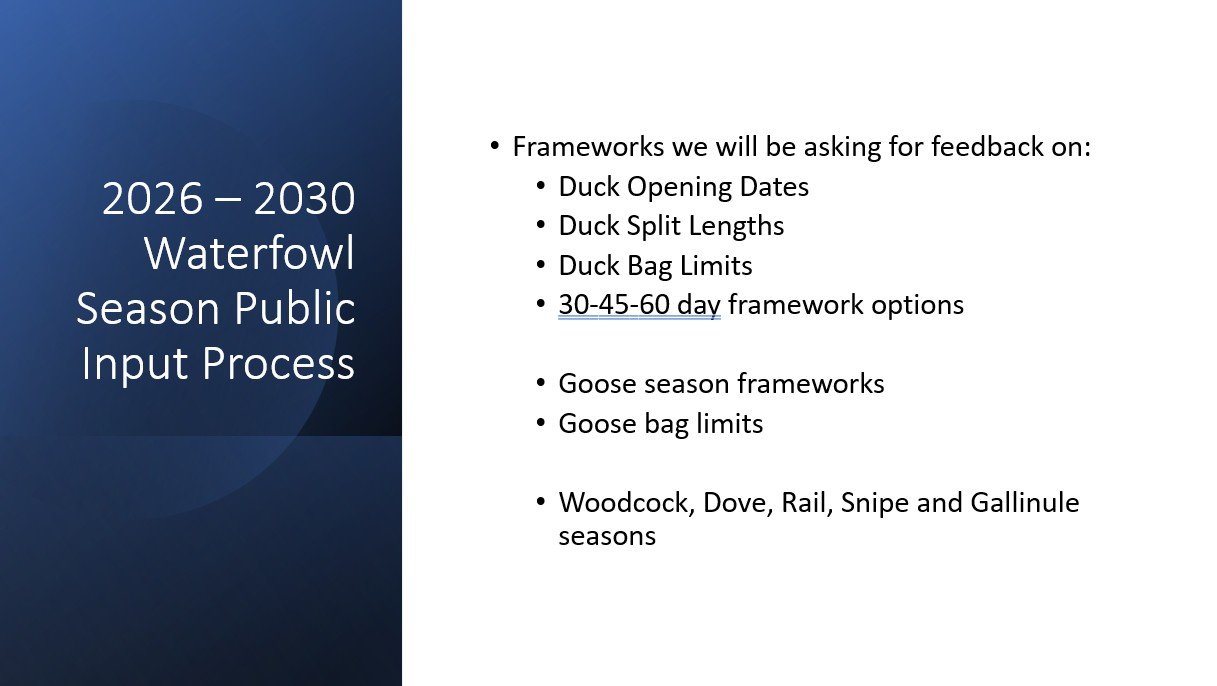
Key Takeaways
- 2026–2030 Season Framework: The DNR is setting a multi-year framework to streamline the annual process, which is justified by data showing 90% of regulations remain unchanged year-to-year. Public input is critical to shape this framework.
- PFAS Contamination: A “do not eat” advisory was issued for mallards from the southern Green Bay Area of Concern (AOC) due to high PFAS levels, especially in juveniles. The DNR is expanding testing statewide.
- Mississippi Flyway Dynamics: The USFWS is disengaging from the flyway system, forcing states to fund their own research (e.g., a new scaup strategy). The flyway is also pushing back on Louisiana’s request to ban flooded corn, citing biological shifts in migration patterns.
- Mallard Genetics: A study found 75% of urban Wisconsin mallards have European game farm genetics, a fitness-reducing trait. The USFWS has ignored flyway requests to ban captive-reared mallards.
Topics
2025 Season Review
- North Zone: A late opener (due to calendar roll) and cool weather created good conditions until a late-season snow and freeze event.
- South Zone: Early teal and wood duck numbers were good, but blue-wings migrated south early after a frost. A rapid freeze-up around deer season ended the season with 4–5 inches of ice.
- Open Water Zone: A difficult season due to low water levels blocking boat access and a lack of birds.
- Migration Data: Tracking data shows mallards from Prairie Canada were already south of Wisconsin by mid-November, refuting the idea that birds wait for the season to close.
Mississippi Flyway & USFWS Dynamics
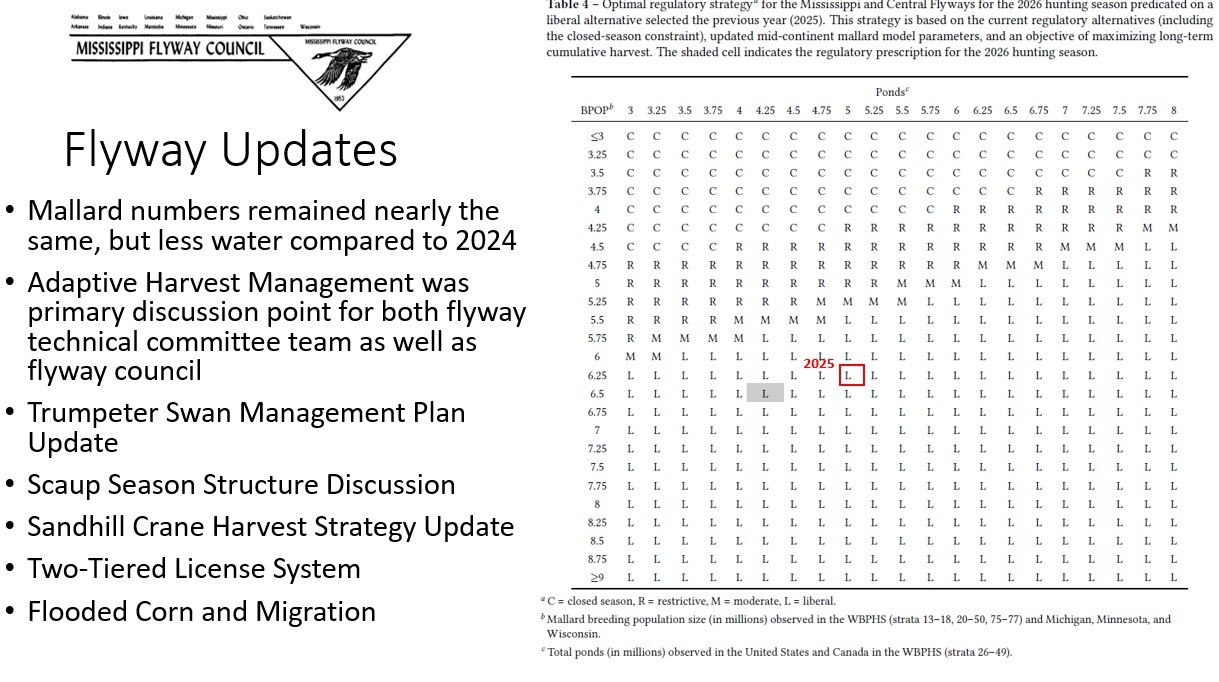
- Adaptive Harvest Management (AHM): The USFWS is disengaging from the successful AHM process, citing resource constraints. This forces states to fund their own research.
- Scaup Harvest Strategy: The Mississippi Flyway is hiring a research scientist to develop a new strategy, replacing the complex 1-bird/15-day, 2-bird/45-day system that lacks biological justification.
- Trumpeter Swan Plan: A new plan is ready for approval, reflecting the population’s success (from a 1990 goal of 260 pairs to ~60,000 today).
- Two-Tiered Licensing: Wisconsin is not adopting this system (which offers a 3-bird “splash limit” to simplify ID) due to concerns about potential misuse on special species (e.g., scaup, canvasbacks).
PFAS Contamination & Consumption Advisory
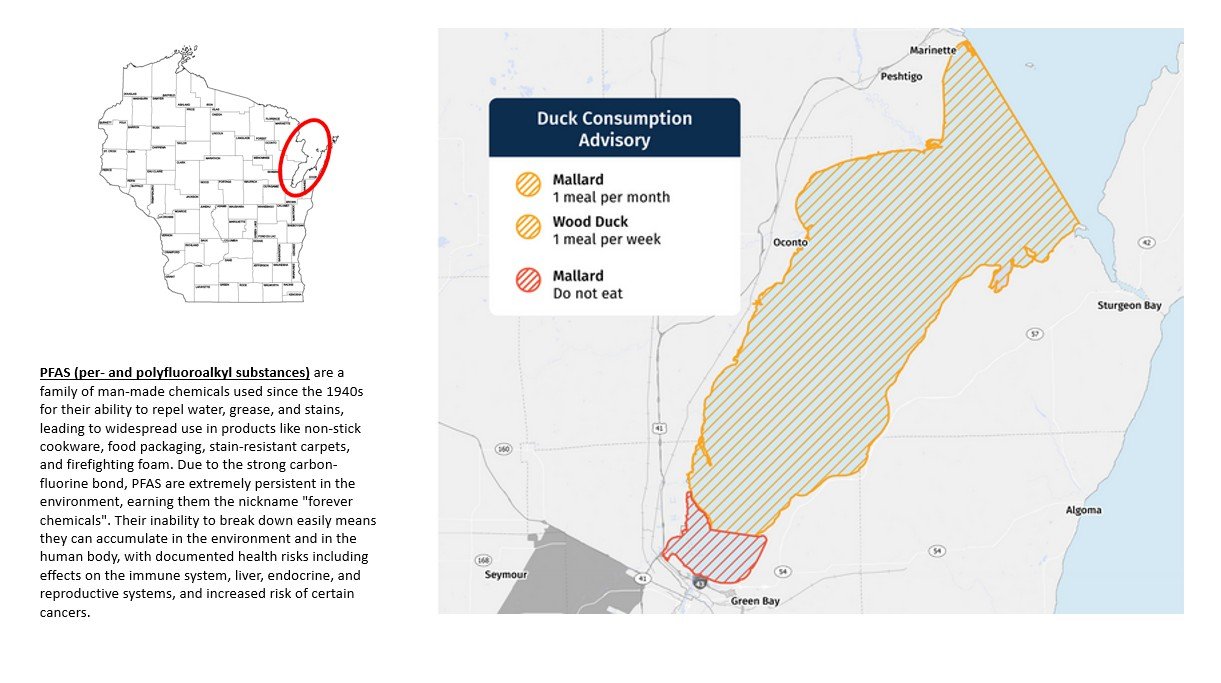
- Advisory Details:
- Rationale: High PFAS levels were found, especially in juvenile mallards (3x the “do not consume” threshold).
- Future Monitoring: The DNR will expand sampling to other species and 6–7 additional sites statewide.
Other Biological & Genetic Concerns
- Hen Mallard Bag Limit: Science shows hen mallard survival is driven by habitat and predation, not hunter harvest. The 2-hen limit will remain.
- Mallard Genetics: A study found 75% of urban Wisconsin mallards have European game farm genetics, a fitness-reducing trait. The USFWS has ignored flyway requests to ban captive-reared mallards.
- Bird Flu (H5N1): No population-level effect on waterfowl is observed, as mallards develop antibodies. Teal are more susceptible due to their shorter lifespans.
- Wood Duck Malaria: UW-Stevens Point research suggests a potential increase in wood duck malaria.
2026–2030 Season Framework
- Process: The DNR is setting a multi-year framework to streamline the annual process.
- Timeline:
- Key Input Areas:
- Opening Dates: Consider fixed dates (e.g., “first Saturday in October”) to avoid early openers.
- Split Lengths: Evaluate interest in the current split structure.
- Goose Season: Provide feedback on opening dates and the holiday hunt.
- Hypothetical Seasons: Define palatable options for a potential 45- or 30-day season (a low-probability but necessary contingency).
Next Steps
- WWA: Encourage members to provide feedback on the 2026–2030 season framework via the WWA/Federation link.
- DNR: Launch the online input tool and hold public meetings in early-mid March.
All: Email Taylor Finger (Taylor.finger@wisconsin.gov) with any questions or comments.


