 By Anna Rzchowski, Public Lands Ecologist
This article appeared in the Wisconsin Waterfowl Association’s September 2026 Newsletter edition.
Pictured above: Anna enjoying summer in the wetlands of the Little Yellow River. Photo credit: Mark Pfost

By Anna Rzchowski, Public Lands Ecologist
This article appeared in the Wisconsin Waterfowl Association’s September 2026 Newsletter edition.
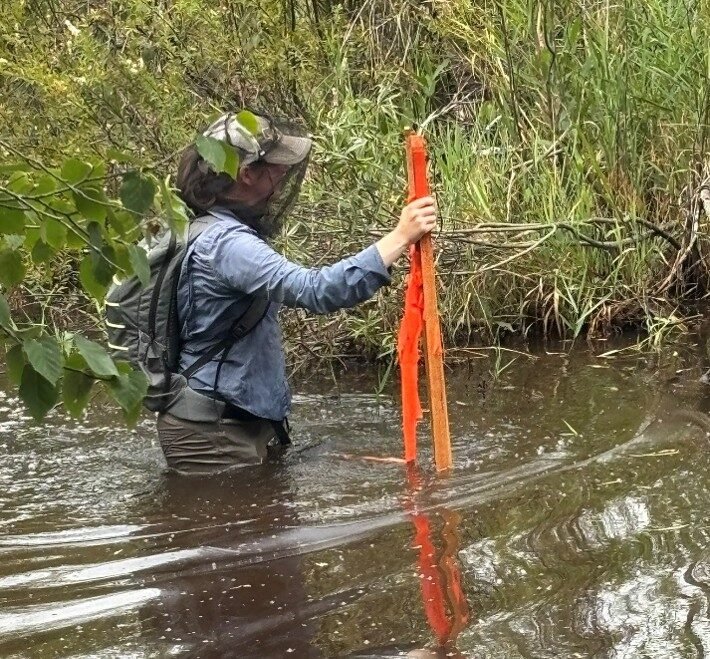
Pictured above: Anna enjoying summer in the wetlands of the Little Yellow River. Photo credit: Mark Pfost
There are months, if not years, of planning before we break ground on a wetland restoration. Long before any dirt gets moved, the site needs to be surveyed, plans developed, funds applied for and secured, permits acquired, and a contractor bid selected for the work. All of this takes time. A LOT of time.
Our public lands restorations are primarily funded through foundation, state, and federal grant dollars. These grant dollars are essential to healthy and productive wetlands on the public land that you and I benefit from every day.
The grant process takes time. Once the restoration designs are finalized, projects are matched to grants and applications are developed and submitted. Finally, grants are awarded and funds released, and work can begin.
We’re nearing construction on the final phase of the Little Yellow River wetland restoration in Juneau County, and the years of effort are about to pay off.
In early August, I drove up to Necedah National Wildlife Refuge to stake the restoration area with Mark Pfost (WWA) and Brad Strobel (USFWS), the project leads. We aimed to walk the ditches slated for restoration this winter, review locations for ditch plugs, and ensure that each plug placement would have the greatest effect.
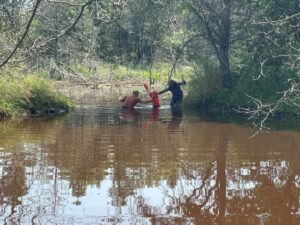
The spoil banks have been in place for roughly one hundred years. Mature trees and brush took advantage of the opportunity, gaining an early foothold in the higher-elevation areas. We spent a good part of the day fighting through scrubby black oaks, flies, and mosquitoes, at times waist-deep (sometimes chin-deep) in water and muck. The occasional wood duck and the promise of what’s to come after this winter’s work provided the motivation to complete our task.
In such a vast wetland system, varying elevations, upland rises scattered throughout, soil characteristics, and a number of other factors all work together to shape what the wetlands will look like, and each area is unique. Nonetheless, the previously restored wetlands along the Neal Lateral Ditch offer a glimpse of what the future may hold. Careful planning by Brad Strobel, Mark Pfost, and the team has resulted in a matrix of sedge meadow, shallow marsh, and other wetland communities as water spreads laterally from the now-disabled ditch.
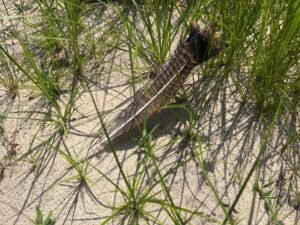
It’s hard to imagine that a ditch ran through some of the older restorations for as long as they did. Pockets of open water are bordered by emergent vegetation and sedge meadow before the wetlands grade up into sandy wooded uplands. Ditch fills completed last winter are dotted with turkey tracks and smartweed, with sedges beginning to reestablish on the bare soil. Waterfowl, American woodcock, shorebirds, reptiles, and amphibians will all benefit from the habitat improvements.
As healthy as these areas look, please remember that these wetlands are still recovering. If you choose to head out there this fall, do your part by bringing clean clothes, boots, and waders free of mud and seeds. The wetlands are relatively free of invasive species- and we’re trying to keep it that way. Healthy wetlands mean healthy waterfowl populations- something we all can get behind.